

 Green Talks
Top Collection of us (Chapter 3)
How Do We Nurture the Next Generation of Green Citizens Between City and Countryside?
"What kind of green citizens do we want to nurture? How do we keep environmentalism from becoming a tired slogan, and instead turn knowledge into active commitment? How do we put sustainability into practice across urban and rural spaces?” When faced with these big questions of environmental education, The Green Earth’s answer is clear: combine hands-on practice with solid research, and tailor learning plans for different audiences—making education a series of grounded, meaningful conversations.
Imagine taking a group of children to a woodland for a storytelling session. In the picture book, the iconic Lion Rock roars; right beside them, staff and volunteers are sweating over newly planted saplings. The stories on the page leap off the paper and come vividly alive before their eyes.
Focusing on Both Urban Areas and Countryside
There are hikers who head to the countryside every weekend, strictly adhering to the rule of “take your litter home”; there are plastic-free advocates who insist on using reusable bags and refuse to take the single-use plastic bags from the market. These green citizens are practising environmentalism, but the hikers may not fully grasp the importance of reducing plastics; similarly, the plastic-free advocates may never have considered that urban lifestyles are intrinsically linked to nature conservation.
Noticing this gap, The Green Earth integrates urban and rural environmental education. By encouraging the public to explore the cause and effect of environmental issues from multiple perspectives, the team aims to deepen awareness and translate understanding into real action for sustainable development.
_website[1].JPG)
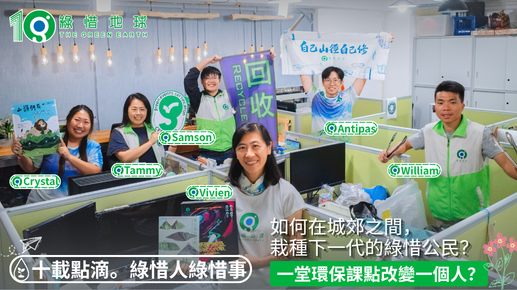
Image: The Green Earth Education Team (From left: Assistant Project Manager Crystal Chan, Project Manager Tammy Tam, Senior Project Officer Samson Chio, Senior Project Officer Antipas Poon, Project Officer William Chan; Bottom: Acting Executive Director & Director of Community Partnership Vivien Cheng)
Bringing Knowledge Down to Earth
Cherishing resources, waste reduction, and nature conservation have always been The Green Earth’s core mission. As a result, the goals of their educational initiatives are razor-sharp. As Vivien Cheng, Acting Executive Director and Director of Community Partnership, explains: “By providing environmental knowledge and practical methods, we awaken the interest of teachers, students, and the public, helping them put green habits into practice in their daily lives.”
Assistant Project Manager Crystal Chan focuses on outdoor environmental education, including Leave No Trace (LNT) education, sustainable trails, and the Country Parks Plantation Enrichment Programme. Meanwhile, Senior Project Officer Samson Chio coordinates the Student Environmental Ambassador Programme, assisting schools and community groups with waste auditing. He also coordinates the Events Go Green Campaign, working with schools and event organisers to pilot environmental initiatives. Both agree that The Green Earth’s strong foundation in waste reduction experiences and policy insights provides solid data and compelling narratives, giving them powerful backing when sharing knowledge with students and the public.
“There’s no shortage of environmental information online, but very little of it offers practical steps,” Samson notes. “Our team brings a wealth of first-hand observations and field survey experience. Combined with scientific methods, our insights offer something far beyond arm-chair online commentary.”
Crystal points to beach cleanups as an example. Rather than simply picking up waste, the team conducts waste audits on-site to analyze the quantity and sources of marine litter, exploring why it washed ashore in the first place. This data is then woven into teaching materials, prompting students to reflect on their own behavior—encouraging them not to dump drink bottles in nature, but to bring them back to urban areas for clean recycling, or better yet, bring reusable containers to prevent waste at source.

Tailoring Approaches for Different Audiences
To change people’s mindset, education should never take a one-size-fits-all approach. On top of that, classroom constraints such as tight teaching schedules and evolving curricula pose constant challenges. That’s why The Green Earth customizes its offerings, from learning objectives and course frameworks to teaching materials and activities, to suit the needs of every learning stage.
Taking kindergartens as an example, picture book storytelling, sing-alongs, and interactive games spark curiosity and motivate young minds. In 2024, the organization published the picture book “What Happened to Our Mountain Friends?”, adapting the seven principles of Leave No Trace into an engaging story. Since not everyone feels confident telling stories, the team has developed supplementary tools like audiobooks, sing-along rhymes, and teacher guides. “There’s always a way to touch a young child’s heart!” smiles Crystal, who coordinated the publication.
Primary school environmental education focuses on experiential learning, such as leading groups to country parks and sharing correct hiking attitudes on-site. The team has also designed interactive gaming educational materials, launching "Universal Recycling Rangers︰How to Handle My 100+ Daily Waste" in 2025. Through gameplay, students learn how to recycle waste generated in daily life and reflect on the challenges involved in the recycling process.
As for secondary school environmental education, elements of 'service learning' have been incorporated. The Green Earth recently piloted a secondary school version of its “Guardians of Mountain Trails - Trail Maintenance Workshop” for geography students. Instructors introduce basic concepts of trail soil erosion and trail sustainability in school visits, followed by field visits to country parks to inspect trail problems firsthand. Students often roll up their sleeves to help maintain water channels—putting their geography knowledge into practice, giving back to nature, and coming to appreciate the interplay between human activity and the environment.
Samson shares that when working with tertiary students who already possess a foundational knowledge base, the focus of education shifts to inspiration. He recently ran a workshop at a local institution using Design Thinking, inviting students to uncover environmental issues on their own campus. “For example, why are there so many rubbish bins around campus? The underlying question is ‘why?’ We want to spark their imagination and encourage them to think about how we can reduce waste at source.”
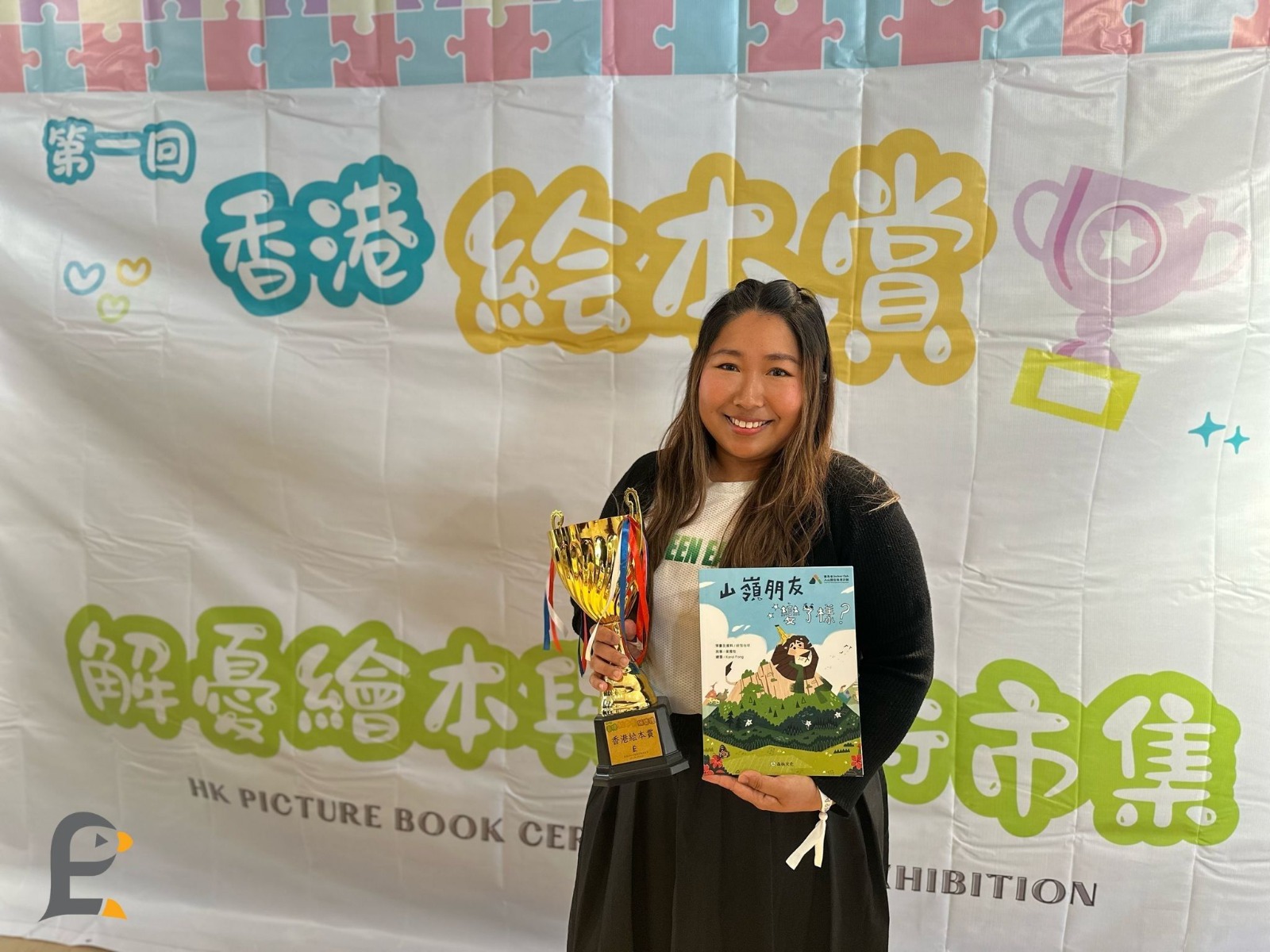
Image: The picture book “What Happened to Our Mountain Friends?” received the Honor of Hong Kong Picture Book Award" at the 1st Hong Kong Picture Book Awards organized by the HK KODOMO EDUCATION CO.
Environmental Education Is Not about Grades
“Learning is not about grades” was a famous slogan two decades ago, reminding parents not to judge their children solely by academic performance. Yet today, with teachers racing through curricula and students under immense study pressure, grade anxiety remains pervasive. Since environmental education is neither an examinable subject nor a shortcut to academic bonus points, how should we evaluate the change it brings?
Crystal compares herself to a farmer, sowing seeds into the hearts of teachers and students, patiently waiting for them to germinate one day. “We gifted our picture books to kindergartens across Hong Kong. After reading it, one principal reached out to exchange ideas, joined our tree-planting events, and later incorporated nature elements into their curriculum—taking kids to local parks to study plants. It turns out a single picture book can inspire a school to dedicate resources to bringing children closer to nature.”
Samson admits that it is unrealistic to expect every participant to turn into an expert in plastic reduction overnight—but that doesn't mean change isn't happening. “I had a delightful encounter recently: a university student suddenly walked up to greet me. I didn't recognize him at first, but he could recount specific details from a talk I had given at his secondary school years ago.” He recently entered a startup competition focused on food waste reduction. “If just one out of a hundred talk attendees makes a change, and goes on to influence others, our efforts create a compound effect.”
With a dedicated education team, The Green Earth has delivered both urban environmental and nature conservation programmes, reaching over one million members of the public and students in 10 years with environmental messages and practical action.
Being able to touch lives makes all the hard work worthwhile for the team. Yet in a fast-paced society that demands instant results, it is challenging to convince sponsors to fund environmental education projects on a long-term basis. Vivien notes with a sigh that many grants last for only one or two years. Just as teaching materials and lesson plans mature and are ready to be scaled up for greater impact, the funding dries up—forcing the team to shelve their hard-won results and start writing new proposals all over again.
Vivien remarks, “Education, by its very nature, is a long‑term and continuous undertaking.”
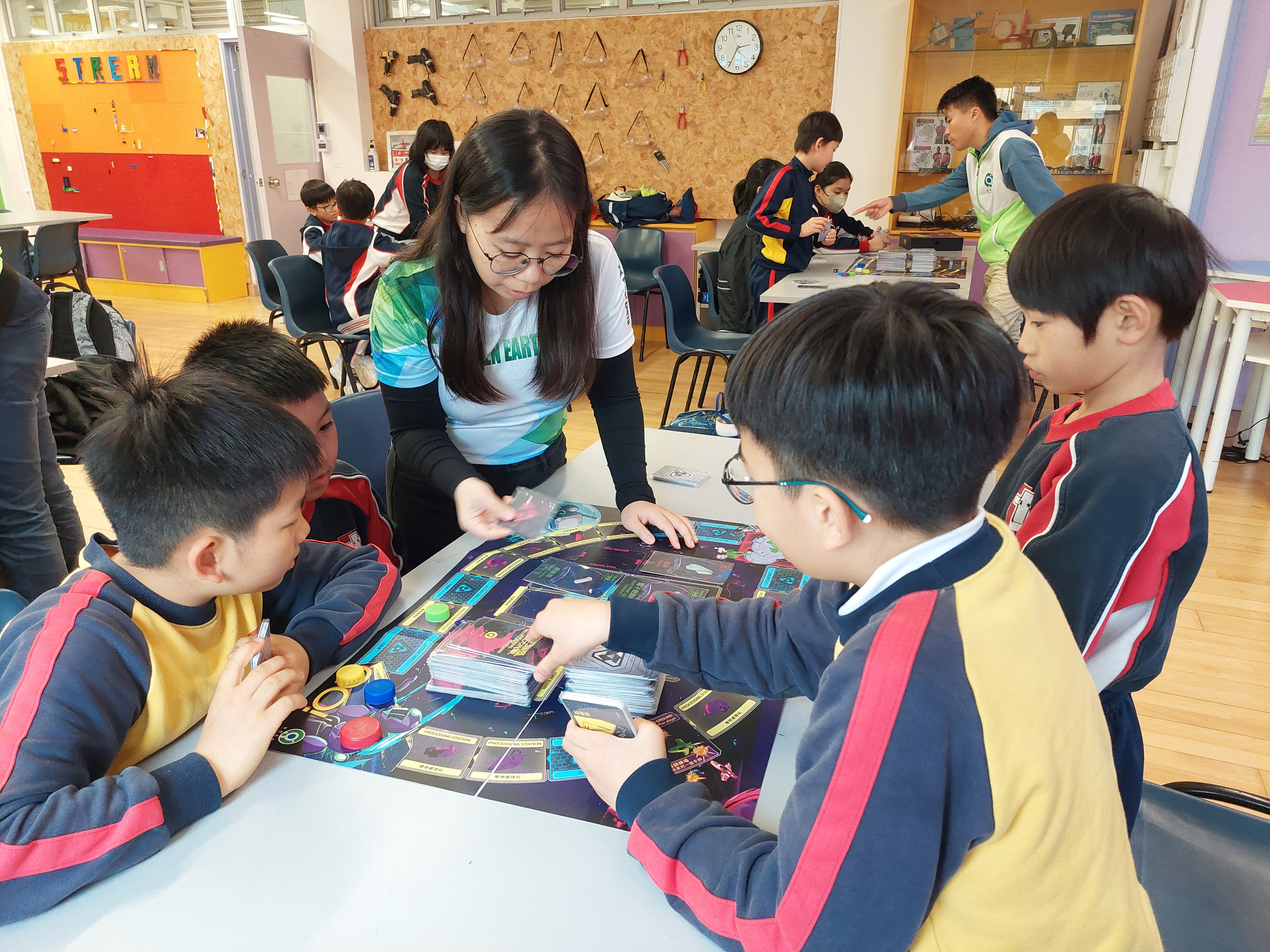
Image: The Green Earth launched the interactive learning game "Universal Recycling Rangers︰How to Handle My 100+ Daily Waste", offering 100 practical recycling tips for daily life to make eco-messages fun and engaging.
Cultivating Green Citizens Who Cherish The Earth
Just as a small seedling never grows into a majestic tree overnight, the seeds of environmental education require steady watering and patience. Remember those children listening to the storybook in the woodland? We look forward to seeing them grow up—not merely as people who go outdoors, but as individuals who truly love and cherish nature.
That is Vivien’s vision of a green citizen: someone whose actions today protect their future self, as well as the world of the generations to come.
----------------------------------
The 'Top Collection of us' series will bring you vibrant stories of The Green Earth throughout the 10th anniversary celebration, stay tuned!
